


How to Improve Operational Precision and Reduce Hand Fatigue with Caulking Guns?
Release Time : 2026-01-29
As an indispensable handheld device in construction, renovation, and home repair, the caulking gun's user experience directly impacts construction quality and operator comfort. During prolonged or high-frequency operations, hand fatigue not only reduces efficiency but also easily leads to uneven glue application and glue overflow. Therefore, improving operational precision and effectively reducing hand fatigue through structural and functional design has become the core objective of caulking gun development. The following analysis focuses on five aspects: ergonomic design, optimized mechanical transmission, lightweight materials, auxiliary control mechanisms, and intelligent trends.
1. Ergonomic Handle Design, Fitting Grip Habits
High-quality caulking gun handles typically feature an asymmetrical shape that conforms to the curvature of the palm, covered with non-slip soft rubber. This increases friction to prevent slippage and cushions localized pressure during force application. Some high-end models also incorporate a "dual grip point" structure—the primary grip area supports the palm, while the secondary grip area allows the fingers to assist in force application, distributing muscle load. Furthermore, the handle angle has been optimized through fluid dynamics simulation, making the adhesive application action closer to the natural wrist movement trajectory and avoiding the risk of tenosynovitis caused by prolonged wrist flexion.
2. Optimized Lever Ratio and Thrust System, Reducing Operating Resistance
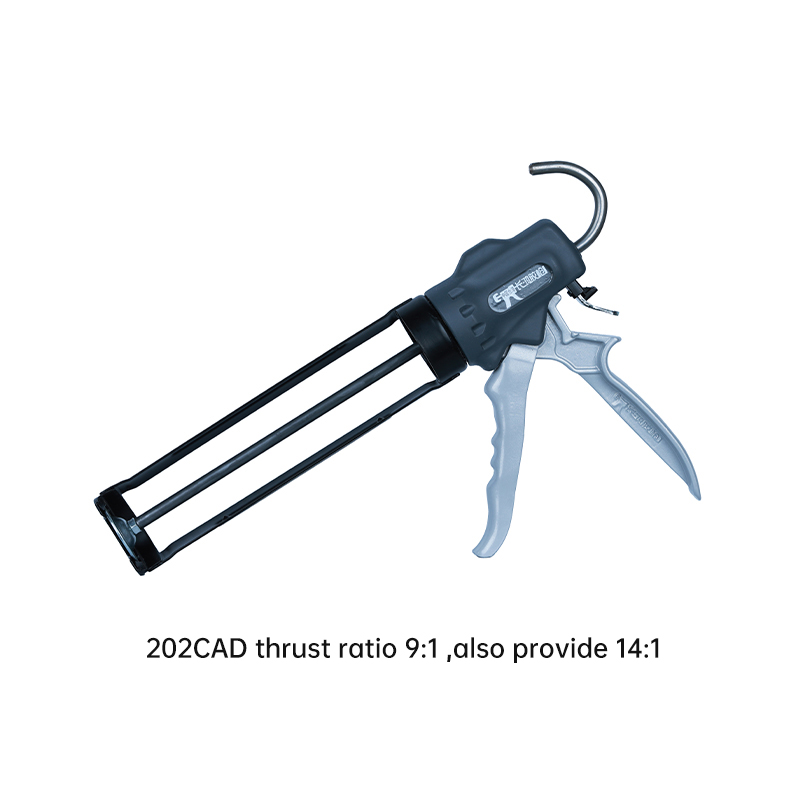
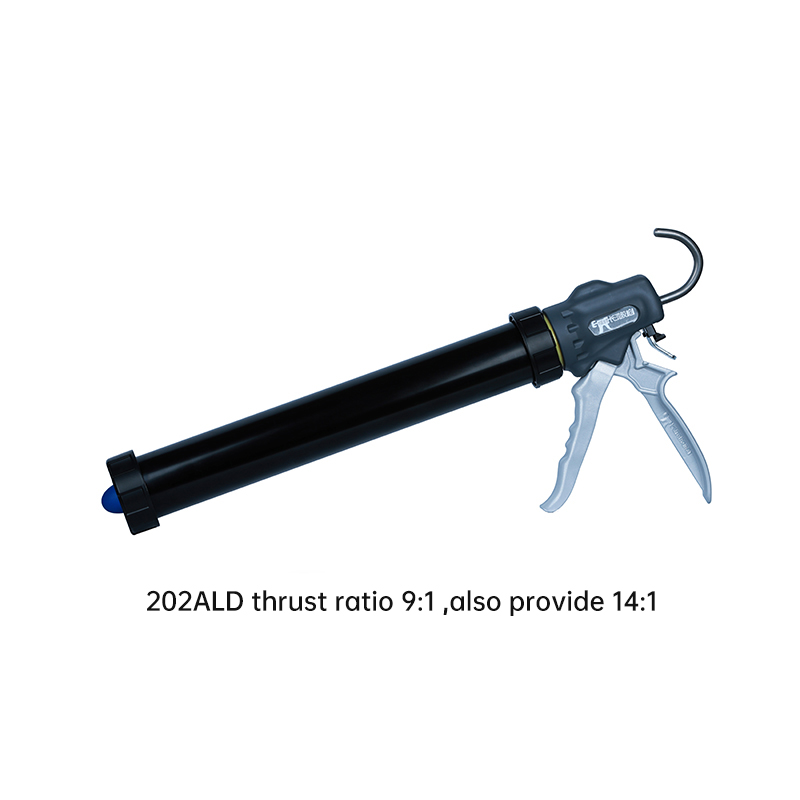
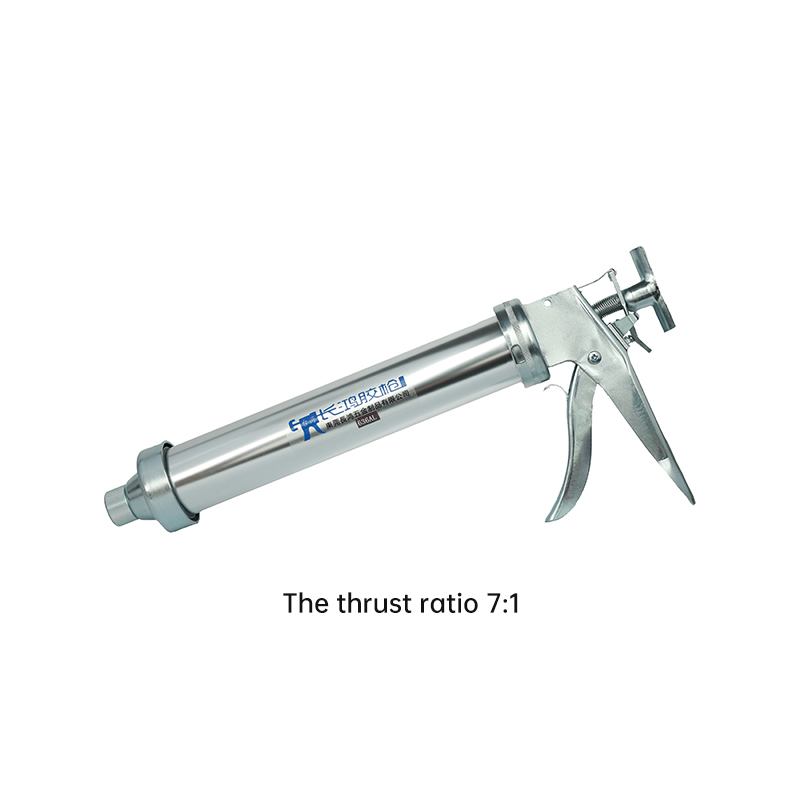
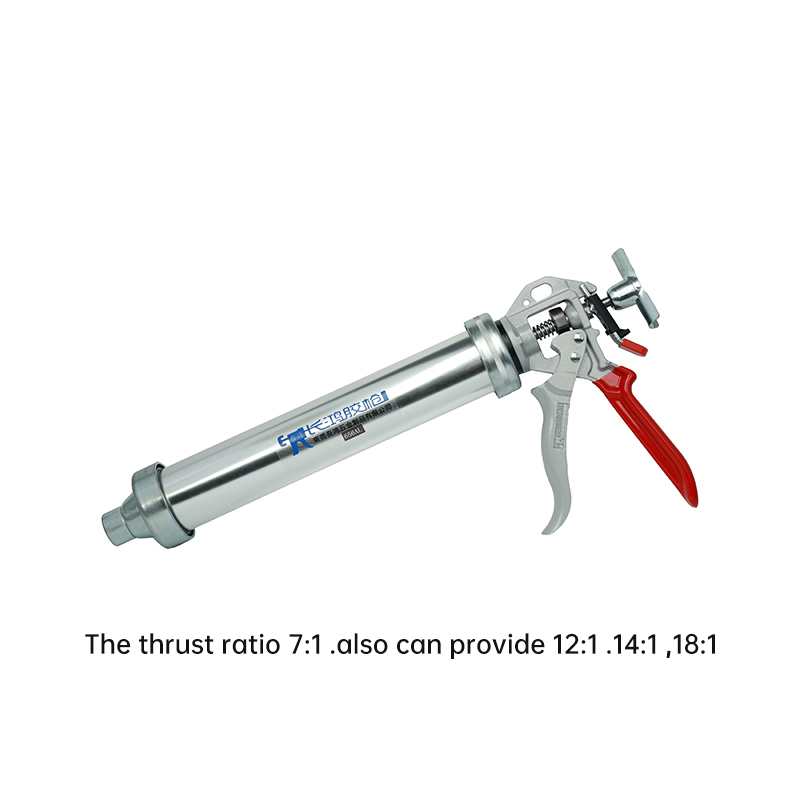
Traditional caulking guns rely on a purely manual trigger to push the piston, requiring significant grip strength when using high-viscosity sealants, easily leading to hand soreness. Modern products, through improved lever mechanisms, efficiently convert the user's grip strength into piston thrust, significantly reducing the required operating force. For example, some professional-grade caulking guns can achieve a thrust ratio of 12:1 or even 18:1, ensuring stable adhesive application while reducing grip strength requirements by more than 40%, greatly alleviating the burden on finger and forearm muscles.
3. Lightweight Body and Balanced Weight, Improving Operational Stability
The overall weight of a caulking gun directly affects fatigue during prolonged use. Using high-strength aluminum alloy or engineering plastics instead of traditional steel in the push rod and frame can reduce weight by 30%–50% while maintaining rigidity. Meanwhile, the designers focused on the overall center of gravity distribution—placing heavier components closer to the handle area to prevent the gun from becoming top-heavy during hovering operation, thus improving pointing stability. This balanced design allows users to move more easily and at a constant speed along the seams, ensuring consistent glue thickness and neat edges.
4. Precise Flow Control and Anti-Drip Mechanism
Precision is not only about "hitting accurately," but also about "controlling it." Advanced caulking guns are equipped with adjustable glue valves or micro-triggers, allowing users to precisely control the glue flow through finger pressure depth, preventing sudden large outflows. At the end, a built-in spring return mechanism quickly pulls back the piston, cutting off the glue flow; some models also integrate an anti-drip lock, which locks the piston position by pressing, completely eliminating glue leakage caused by residual pressure. These detailed designs eliminate the need for repeated wiping or repairs, increasing the success rate of one-time molding.
5. Introduction of Electric and Intelligent Assistive Technologies
To completely liberate manpower, electric caulking guns are gradually becoming more widespread. Driven by a micro-motor, the piston allows users to achieve constant-speed glue dispensing with a simple button press, completely eliminating the need for manual pushing. Furthermore, some intelligent models are equipped with pressure sensors and feedback systems that automatically adjust the dispensing speed based on the remaining amount in the glue cartridge, maintaining consistent glue dispensing. They can even be pre-set with an app to adjust glue line width and flow rate, achieving semi-automated operation. This technology is particularly suitable for high-intensity applications such as large-area curtain wall sealing and industrial assembly, fundamentally solving the problem of hand strain.
In summary, modern extrusion sealant tools have evolved from simple mechanical devices into precision tools integrating human factors engineering, materials science, and intelligent control. Through scientific structural design and technological innovation, they have not only significantly improved the accuracy and aesthetics of glue application but also effectively protected the health of construction workers. In the future, with the in-depth application of lightweight composite materials and human-computer interaction technology, the operating experience of caulking guns will continue to evolve towards "zero fatigue, high precision, and intelligence."
1. Ergonomic Handle Design, Fitting Grip Habits
High-quality caulking gun handles typically feature an asymmetrical shape that conforms to the curvature of the palm, covered with non-slip soft rubber. This increases friction to prevent slippage and cushions localized pressure during force application. Some high-end models also incorporate a "dual grip point" structure—the primary grip area supports the palm, while the secondary grip area allows the fingers to assist in force application, distributing muscle load. Furthermore, the handle angle has been optimized through fluid dynamics simulation, making the adhesive application action closer to the natural wrist movement trajectory and avoiding the risk of tenosynovitis caused by prolonged wrist flexion.
2. Optimized Lever Ratio and Thrust System, Reducing Operating Resistance
Traditional caulking guns rely on a purely manual trigger to push the piston, requiring significant grip strength when using high-viscosity sealants, easily leading to hand soreness. Modern products, through improved lever mechanisms, efficiently convert the user's grip strength into piston thrust, significantly reducing the required operating force. For example, some professional-grade caulking guns can achieve a thrust ratio of 12:1 or even 18:1, ensuring stable adhesive application while reducing grip strength requirements by more than 40%, greatly alleviating the burden on finger and forearm muscles.
3. Lightweight Body and Balanced Weight, Improving Operational Stability
The overall weight of a caulking gun directly affects fatigue during prolonged use. Using high-strength aluminum alloy or engineering plastics instead of traditional steel in the push rod and frame can reduce weight by 30%–50% while maintaining rigidity. Meanwhile, the designers focused on the overall center of gravity distribution—placing heavier components closer to the handle area to prevent the gun from becoming top-heavy during hovering operation, thus improving pointing stability. This balanced design allows users to move more easily and at a constant speed along the seams, ensuring consistent glue thickness and neat edges.
4. Precise Flow Control and Anti-Drip Mechanism
Precision is not only about "hitting accurately," but also about "controlling it." Advanced caulking guns are equipped with adjustable glue valves or micro-triggers, allowing users to precisely control the glue flow through finger pressure depth, preventing sudden large outflows. At the end, a built-in spring return mechanism quickly pulls back the piston, cutting off the glue flow; some models also integrate an anti-drip lock, which locks the piston position by pressing, completely eliminating glue leakage caused by residual pressure. These detailed designs eliminate the need for repeated wiping or repairs, increasing the success rate of one-time molding.
5. Introduction of Electric and Intelligent Assistive Technologies
To completely liberate manpower, electric caulking guns are gradually becoming more widespread. Driven by a micro-motor, the piston allows users to achieve constant-speed glue dispensing with a simple button press, completely eliminating the need for manual pushing. Furthermore, some intelligent models are equipped with pressure sensors and feedback systems that automatically adjust the dispensing speed based on the remaining amount in the glue cartridge, maintaining consistent glue dispensing. They can even be pre-set with an app to adjust glue line width and flow rate, achieving semi-automated operation. This technology is particularly suitable for high-intensity applications such as large-area curtain wall sealing and industrial assembly, fundamentally solving the problem of hand strain.
In summary, modern extrusion sealant tools have evolved from simple mechanical devices into precision tools integrating human factors engineering, materials science, and intelligent control. Through scientific structural design and technological innovation, they have not only significantly improved the accuracy and aesthetics of glue application but also effectively protected the health of construction workers. In the future, with the in-depth application of lightweight composite materials and human-computer interaction technology, the operating experience of caulking guns will continue to evolve towards "zero fatigue, high precision, and intelligence."